

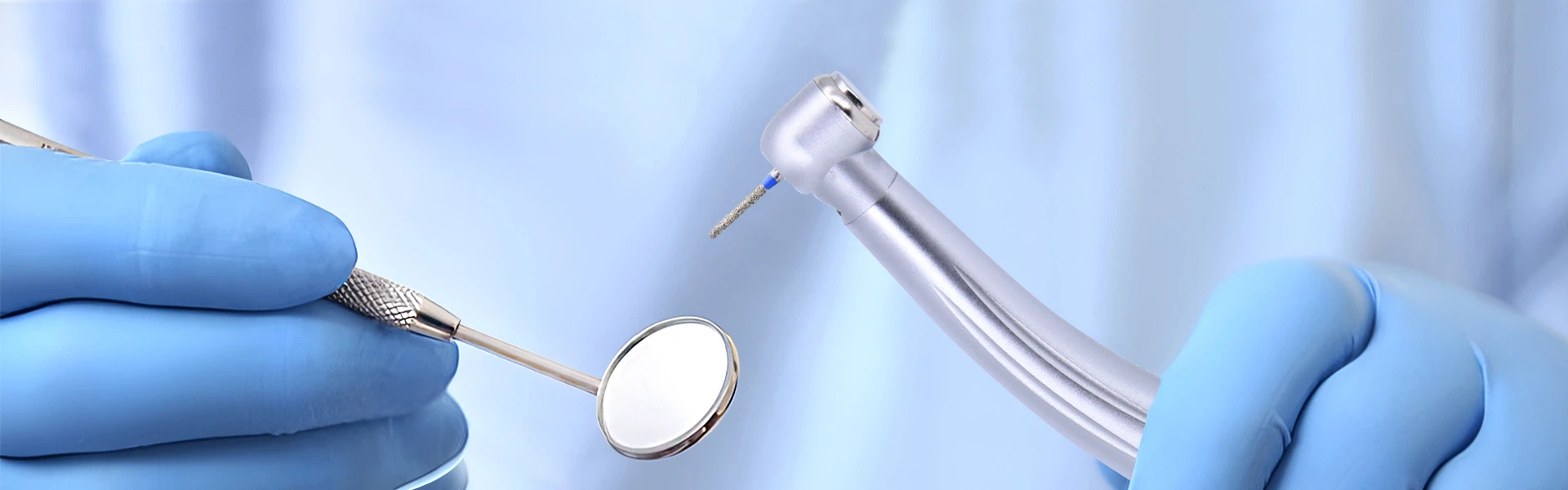
Standard Operating Specifications for Dental Handpieces
Compliant Operation, Loss Control & Infection Prevention
1. Pre-Operation Standard Inspection - Avoid Using Faulty Equipment
Thorough pre-treatment inspection serves as the first line of defense to ensure smooth diagnosis and treatment and eliminate equipment risks, which is an indispensable and easily overlooked procedure.
① Sterilization Validation
Before use, strictly check the integrity, validity period and sterilization mark of the handpiece packaging. Never use handpieces with damaged, damp or expired packaging or unqualified sterilization results to fundamentally prevent cross-infection.
② Basic Equipment Testing
Connect the handpiece to the dental unit and conduct no-load tests on the air circuit, water circuit and optical fiber functions. Check for water leakage, air leakage, uneven water spray, flickering light and unstable rotation speed. Faulty equipment is prohibited for clinical use.
③ Standard Bur Selection and Installation
Adopt qualified standard burs without bending, deformation or damage. Discard worn, defective or mismatched burs. Insert the bur fully into position and fasten the chuck firmly. Pull the bur slightly after installation to confirm no looseness, preventing bur detachment during high-speed operation, clinical accidents and internal mechanism damage. Idle operation without an installed bur is strictly forbidden to avoid unnecessary wear of the clamping structure.
④ Air Pressure Parameter Calibration
Strictly follow standard working pressure parameters. The standard pressure for conventional high-speed handpieces is 0.2–0.23 Mpa; overpressure operation is prohibited. Excessive pressure accelerates bearing wear and shortens service life, while insufficient pressure causes weak cutting power and low clinical efficiency. Ensure the air and water supply is free of oil, water and impurities before operation.
2. Standard Intra-Operation Procedures - Ensure Safety and Reduce Wear
Operational details during clinical treatment directly determine the service life and working stability of dental handpieces. Refined standardized operation effectively reduces implicit equipment loss.
① Standard Start-Stop & Gentle Operation
Handle handpieces gently at all times. Avoid collision, dropping or prying tooth tissues with force. Perform smooth start and stop actions; frequent rapid switching and prolonged high-speed idling are prohibited to reduce ineffective wear of bearings and turbines. Wait for the handpiece to stop completely before replacing burs or adjusting operating positions; never touch or disassemble burs during operation.
② Water-Cooled Operation - Dry Grinding Prohibited
Sufficient cooling water must be turned on during all tooth preparation and cutting procedures. Dry grinding causes instantaneous overheating of the handpiece head, which may injure dental and periodontal tissues and permanently damage handpiece bearings and sealing structures due to high temperature.
③ Reasonable Load & Alternated Use
Avoid prolonged continuous overload operation of a single handpiece. For complex treatments, alternate between two handpieces to prevent overheating and fatigue aging of bearings and internal mechanisms. Match handpiece models with clinical scenarios; do not apply small handpieces for high-load posterior tooth access and precise preparation to avoid overload damage.
④ Immediate Shutdown Upon Abnormality
Stop operation immediately if abnormal conditions occur, including strange noise, severe vibration, jamming, water leakage and sudden speed drop. Troubleshoot faults in a timely manner. Never continue using defective handpieces to prevent fault escalation and potential safety hazards.
3. Immediate Post-Operation Pretreatment - Standardize Sterilization Connection
Bedside post-operation pretreatment is critical for removing pipeline contaminants, preventing biofilm formation and ensuring sterilization effectiveness. Implement strict one-patient-one-cleaning and one-patient-one-sterilization protocols.
① Pipeline Flushing and Decontamination
Keep the bur in place after treatment, and run the handpiece with water and air for no less than 30 seconds to thoroughly flush residual blood, dental debris and contaminants inside the water and air pipelines, preventing residue scaling, biofilm growth and bacterial retention.
② Surface Cleaning and Standard Recycling
Remove the bur after the handpiece completely stops. Gently wipe surface contaminants with sterile damp cotton swabs. Do not immerse the entire handpiece in liquid or scratch the handpiece head and optical fiber end face with hard tools. Place cleaned contaminated handpieces into dedicated recycling containers immediately; random placement and cross stacking are prohibited.
③ Pre-Sterilization Maintenance
Apply dedicated dental handpiece lubricant for professional lubrication after pretreatment to fully lubricate bearings and pipelines, then wipe off excess oil. Always follow the principle of lubrication before sterilization to avoid grease carbonization and mechanism jamming caused by high-temperature sterilization.
4. Core Operation Prohibitions - Eliminate All Violative Behaviors
Clarifying operational red lines to avoid equipment damage and infection control violations is an essential professional criterion for all dental practitioners.
① Low-quality, deformed, bent, damaged or mismatched burs are prohibited;
② Dry grinding under water-deficient conditions and idling without burs are prohibited;
③ Over-pressure, over-load and prolonged continuous high-speed operation are prohibited;
④ Violent bur installation and removal, collision, dropping and forced prying operation are prohibited;
⑤ Dry heat disinfection and chemical immersion disinfection are prohibited; only Class B high-pressure steam sterilization is compliant;
⑥ Secondary contaminated or expired sterilized handpieces are prohibited for clinical use;
⑦ Defective handpieces with abnormal noise, eccentricity and vibration are prohibited for treatment.