

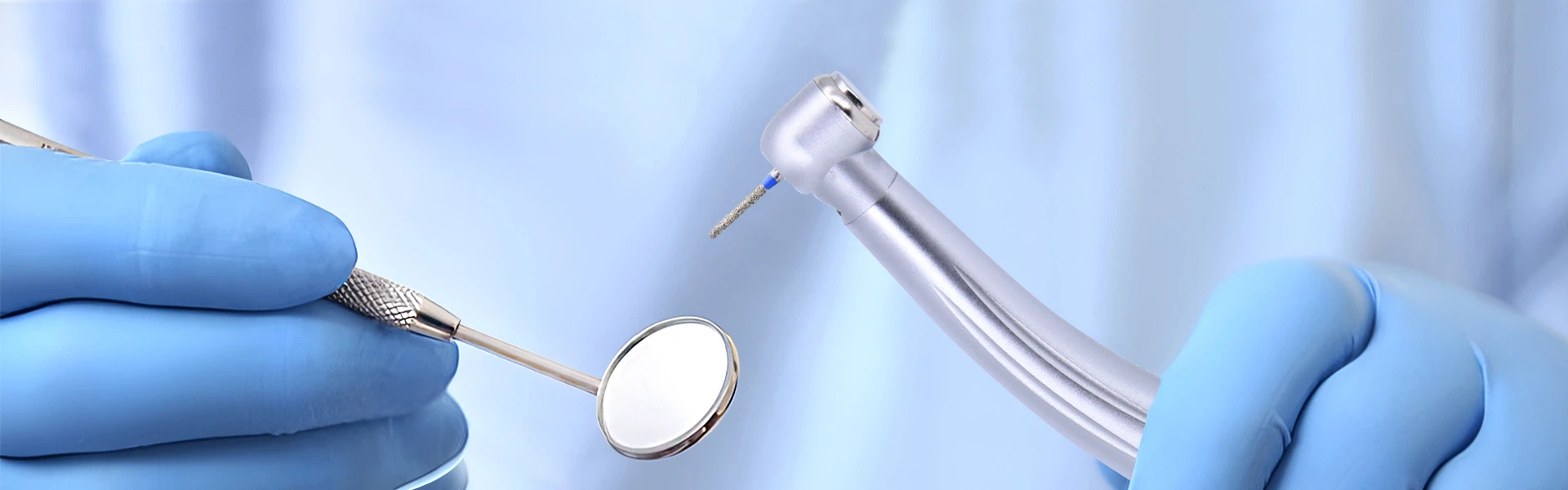
Dental Handpiece Professional Maintenance Guide
Standard Maintenance to Extend Service Life & Stabilize Clinical Performance
-
Standard Operation During Use - Minimize Equipment Wear from the Source
Most implicit damage to dental handpieces stems from improper clinical operation. Standard daily use is the foundation of maintenance and far more effective than post-damage repair.
① Standard Bur Installation and Removal, Avoid Violent Operation
Install and lock the bur firmly in place. Never operate the handpiece with an unsecured or loose bur, nor run the handpiece idle without a fixed bur. After treatment, wait for the handpiece to stop completely before removing the bur. Do not pull or pry the bur while the handpiece is running at high speed, so as to prevent damage to the collet, chuck and bearing structure.
② Control Working Air Pressure to Match Equipment Parameters
Adjust the dental chair air pressure in advance. The working air pressure for standard handpieces shall not exceed 40 PSI unless otherwise specified. Excessively high air pressure accelerates bearing wear and movement aging, while insufficient air pressure leads to low rotation speed and poor treatment results. Ensure the air and water supply for treatment is free of water, oil and impurities to prevent pipeline blockage caused by foreign particles.
③ Avoid Overload Operation and Collision Damage
Avoid prolonged high-speed idling during treatment to reduce unnecessary wear. Handle the handpiece gently at all times. Prevent dropping, colliding or applying excessive force during tooth preparation. Precision turbine mechanisms will suffer irreversible damage such as eccentricity, vibration and abnormal noise after impact.
-
Immediate Postoperative Cleaning - Prevent Residue Corrosion
Timely cleaning after each use is critical to preventing pipeline blockage, metal corrosion and bacterial growth. One-use-one-cleaning is mandatory; accumulated cleaning is prohibited.
① Surface Decontamination
Remove the bur immediately after treatment. Wipe off blood, dental calculus and debris on the handpiece surface with a clean soft cloth and clean water. For fiber-optic handpieces, gently wipe the fiber end face with a cotton swab; avoid hard scratching to prevent reduced lighting performance. Do not immerse the entire handpiece in water to avoid internal water infiltration into the precision movement.
② Pipeline Dredging and Residue Removal
Clean residual debris from the bur hole and water spray hole with a professional fine brush. Run the handpiece idle for 10 to 15 seconds to expel residual water and contaminants inside the pipeline, preventing residue scaling, blockage and internal pipeline corrosion.
-
Core Maintenance - Professional Lubrication to Determine Service Life
Lubrication is the core and most error-prone step of handpiece maintenance. Direct sterilization without standardized lubrication causes internal grease carbonization, bearing jamming and movement rusting, which are the leading causes of handpiece scrapping.
① Use Specialized Consumables - No Substitution
Only special professional dental handpiece cleaning and lubricating oil is allowed. Never use petrolatum, ordinary machine oil or household lubricants. Non-dedicated oils have inappropriate viscosity and poor high-temperature resistance, which will carbonize and agglomerate after sterilization and damage precision bearings permanently.
② Standard Lubrication SOP
Disconnect the handpiece connector and install a dedicated lubrication adapter. Align the nozzle with the air inlet at the handpiece tail (the large hole for 2-hole handpieces, the second largest hole for 4-hole handpieces) and spray continuously for 1 to 2 seconds. Reconnect the handpiece and run it at low speed for about 10 seconds to evenly coat bearings and gears with lubricant and expel excess oil until clean oil flows out steadily.
③ Core Principle: Lubricate Before Sterilization
All handpieces must be cleaned, lubricated and dried before packaging and sterilization. Never perform high-temperature sterilization on dry unlubricated handpieces. High temperature will carbonize residual contaminants and old grease inside, resulting in bearing jamming, speed attenuation and abnormal noise.
-
Standard Sterilization & Cooling - Avoid Secondary Damage
Detailed standardized sterilization procedures directly affect handpiece stability and durability and must comply with oral instrument disinfection and sterilization specifications.
① Control Sterilization Parameters
Adopt Class B high-pressure steam sterilization with a maximum temperature of 135℃ to prevent damage to internal sealing structures and fiber-optic components caused by overheating. Avoid repeated prolonged high-temperature sterilization to reduce equipment aging.
② Natural Cooling - Forbidden Improper Operations
After sterilization, place handpieces in a clean area to cool naturally to room temperature. Never cool them with cold water or strong cold wind, as extreme temperature difference causes thermal expansion and contraction deformation of precision components. Do not leave handpieces inside the sterilizer overnight, as humid and high-temperature environments lead to bacterial growth and component corrosion.
-
Daily Storage & Regular Inspection - Long-Term Equipment Protection
Much handpiece wear results from improper storage and accumulated hidden faults rather than normal use. Refined daily management is essential.
① Dry and Sealed Storage
Store fully cooled and dry handpieces in a clean, dry and ventilated professional instrument cabinet, away from humidity, dust and corrosive substances. For long-term idle handpieces, perform pre-storage lubrication and regular idle running maintenance to prevent bearing jamming and rusting.
② Regular Inspection and Maintenance
Weekly routine inspection: check water spray, air spray and lighting functions; inspect for vibration, abnormal noise, jamming and water leakage; clean residual dirt on connector threads and sealing rings. Monthly in-depth maintenance: thoroughly clean pipelines and inspect gear and bearing conditions. Arrange annual professional full-machine inspection by manufacturers to eliminate hidden faults and extend equipment service life.
-
Common Maintenance Misconceptions & Corrections
① Misconception: Frequent high-speed idling for flushing|Correction: Short-time low-speed idling is sufficient to avoid unnecessary bearing wear;
② Misconception: Lubricate after sterilization|Correction: Grease fails and carbonizes after sterilization; lubrication must be completed before sterilization;
③ Misconception: Mix different types of lubricants and cleaning oils|Correction: Only dedicated consumables match precision mechanisms to avoid damage;
④ Misconception: Continue using collided handpieces|Correction: Impact easily causes movement eccentricity; inspect before reuse.