

How does a dental curing light work?
As a leading supplier of dental equipment, I'm often asked about the intricacies of dental curing lights. These devices play a crucial role in modern dentistry, and understanding how they work can provide valuable insights for both dental professionals and those interested in the field.
The Basics of Dental Curing
Before delving into the workings of a dental curing light, it's important to understand the concept of dental curing itself. In dentistry, curing refers to the process of hardening a dental material, typically a composite resin. Composite resins are widely used in restorative dentistry for filling cavities, bonding veneers, and other cosmetic and functional applications.
These resins are initially in a soft, malleable state, which allows dentists to shape them precisely to fit the patient's tooth. However, they need to be hardened to provide long - lasting strength and durability. This is where dental curing lights come in.
The Science Behind Dental Curing Lights
Dental curing lights work based on the principle of photopolymerization. Photopolymerization is a chemical reaction in which a liquid or semi - liquid resin is transformed into a solid polymer when exposed to specific wavelengths of light.
Most modern dental curing lights use light - emitting diodes (LEDs). LEDs have several advantages over traditional curing light technologies, such as halogen lights. They are more energy - efficient, produce less heat, and have a longer lifespan.
The specific wavelengths of light emitted by dental curing lights are in the blue spectrum, typically around 400 - 500 nanometers. This range of wavelengths is absorbed by photoinitiators present in the composite resin. Photoinitiators are chemicals that, when activated by light, start a chain reaction that causes the resin monomers to link together, forming a solid polymer.
Components of a Dental Curing Light
A typical dental curing light consists of several key components:
- Light Source: As mentioned earlier, LEDs are the most common light source in modern dental curing lights. The LEDs are carefully selected to emit light at the optimal wavelengths for photopolymerization.
- Optics: The optics of a dental curing light are designed to focus and direct the light onto the dental material. This ensures that the light is evenly distributed over the area being cured, resulting in a more uniform and complete cure.
- Power Supply: Dental curing lights require a power source to operate. Some are battery - powered, which offers portability and convenience, while others are connected to a power outlet for continuous use.
- Control Mechanism: There is usually a control mechanism, such as a button or a foot pedal, that allows the dentist to turn the light on and off and control the duration of the curing process.
The Curing Process
When a dentist uses a dental curing light, the process typically follows these steps:
- Preparation: The dentist first prepares the tooth surface by cleaning and etching it. Then, the composite resin is applied to the tooth in the desired shape.
- Positioning: The dental curing light is positioned close to the composite resin. The tip of the light should be as close as possible to the material to ensure maximum light intensity and effective curing.
- Activation: The dentist activates the curing light using the control mechanism. The light is then shone on the composite resin for a specific period of time, usually ranging from 20 - 40 seconds, depending on the type of resin and the manufacturer's instructions.
- Curing Completion: After the specified curing time, the light is turned off. The composite resin has now hardened into a solid material, and the restoration is complete.
Importance of Proper Curing
Proper curing is essential for the success of dental restorations. If the composite resin is not cured correctly, it may not have the desired strength and durability, which can lead to issues such as wear, chipping, or leakage around the restoration.

Insufficient curing can also result in a higher risk of secondary caries (new cavities forming around the restoration). On the other hand, over - curing can cause excessive shrinkage of the resin, which may lead to marginal gaps and stress on the tooth structure.
Quality and Performance of Dental Curing Lights
When choosing a dental curing light, several factors should be considered to ensure its quality and performance:
- Light Intensity: The light intensity of a dental curing light is measured in milliwatts per square centimeter (mW/cm²). A higher light intensity generally results in a faster and more complete cure. However, it's important to use the appropriate intensity for the specific composite resin being used.
- Spectrum: As mentioned earlier, the light spectrum should be in the blue range (400 - 500 nanometers) to effectively activate the photoinitiators in the resin.
- Curing Time: Different dental curing lights may have different recommended curing times. It's important to follow the manufacturer's instructions to ensure proper curing.
Our Product Range
As a dental curing light supplier, we offer a wide range of high - quality products. One of our popular products is the Dental LED Oral Filling Light Unit. This unit is equipped with advanced LEDs that emit light at the optimal wavelengths for efficient photopolymerization. It also has a well - designed optical system that ensures even light distribution.
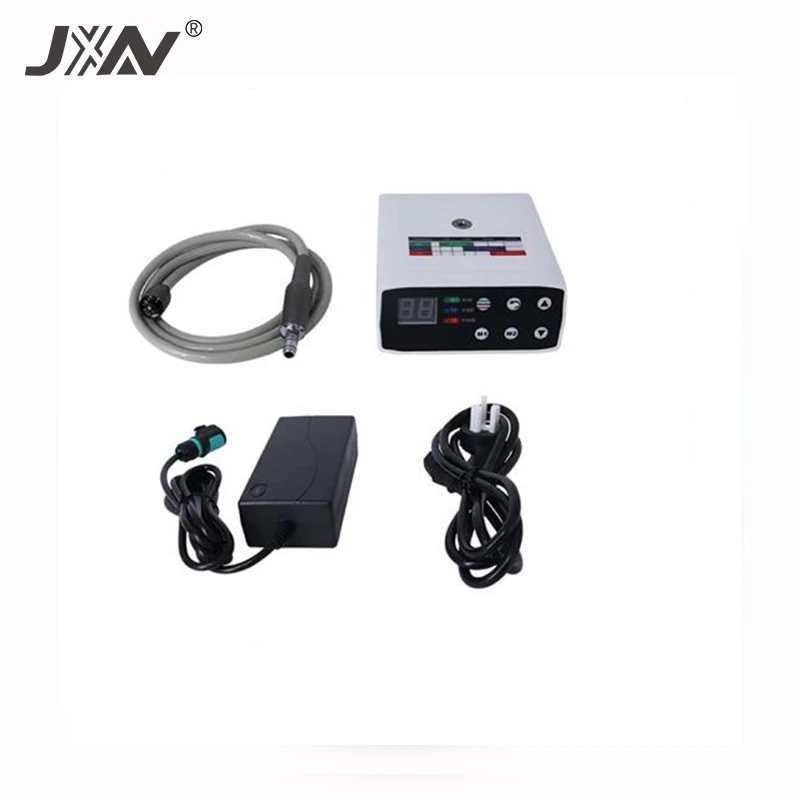
In addition to our dental curing lights, we also provide other dental equipment such as the Dental Electric Brushless LED Micro Motor and the Endo Activator. These products are designed to meet the diverse needs of dental professionals.
Contact Us for Purchase and Discussion
If you are interested in our dental curing lights or other dental equipment, we invite you to contact us for further discussion. We have a team of experts who can provide you with detailed product information, answer your questions, and assist you in making the right choice for your dental practice. Whether you are a small dental clinic or a large dental hospital, we are committed to providing you with the best products and services.
References
- "Dental Materials: Properties and Manipulation" by John M. Powers and Roger W. Sakaguchi.
- "Photopolymerization in Dentistry" research papers from the Journal of Dental Research.