

Hey there! If you're in the dental field, you know how important dental accessories are. As a dental accessories supplier, I've seen it all. Today, I'm gonna share with you some of the most common dental accessories that you'll often come across in dental clinics and practices.
Let's start with handpiece rotors. These are crucial parts of dental handpieces, which are used for a variety of procedures like drilling, polishing, and cutting. There are two main types: low speed and high speed.
The Low Speed Handpiece Cartridge Rotor is great for tasks that require more control and precision. It operates at a slower speed, usually between 10,000 and 40,000 revolutions per minute (RPM). This makes it ideal for things like filling cavities, removing decay, and performing root canal treatments. The low - speed handpiece allows dentists to work carefully and accurately, especially in tight spaces.

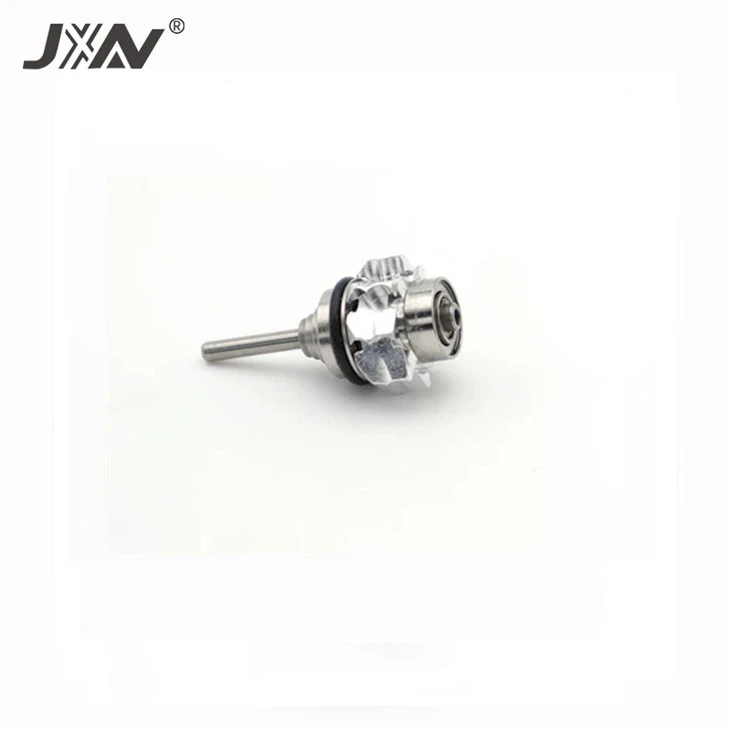
On the other hand, the High Speed Handpiece Cartridge Rotor is designed for faster procedures. It can reach speeds of up to 400,000 RPM or even higher. High - speed handpieces are used for quickly removing large amounts of tooth structure, like when preparing a tooth for a crown or doing major restorations. They're really powerful and can get the job done in a shorter amount of time.
Another essential accessory is the Dental Handpiece Connect Tube. This tube is what connects the handpiece to the dental unit. It's responsible for delivering air, water, and sometimes electricity to the handpiece. Without a proper connect tube, the handpiece won't function correctly. The tube needs to be flexible enough to allow easy movement of the handpiece during procedures, but also durable to withstand the wear and tear of regular use.
Now, let's talk about burs. Burs are the cutting tools that are attached to the handpieces. There are different types of burs for different purposes. For example, diamond burs are great for cutting through hard materials like enamel and dentin. They have a rough surface made of diamond particles, which allows them to grind away the tooth structure effectively. Carbide burs, on the other hand, are used for more general cutting and shaping. They're made of a hard metal alloy and are available in various shapes and sizes, such as round, fissure, and tapered.
Dental mirrors are also a staple in any dental practice. They come in different sizes and shapes, but their main function is to help the dentist see areas of the mouth that are otherwise difficult to access. A dental mirror can reflect light into the back of the mouth, allowing the dentist to examine the teeth and gums thoroughly. Some mirrors even have a magnifying feature, which can be really useful for detecting small cavities or other dental problems.
Dental syringes are used for a variety of tasks, such as injecting anesthetic, applying fluoride treatments, or delivering irrigation solutions. There are different types of syringes, including disposable and reusable ones. Disposable syringes are more convenient and hygienic, as they can be thrown away after use, reducing the risk of cross - contamination. Reusable syringes, on the other hand, need to be properly sterilized between uses.
Dental suction tips are another important accessory. They're used to remove saliva, blood, and debris from the patient's mouth during procedures. This helps keep the working area clean and dry, making it easier for the dentist to perform the treatment. There are different types of suction tips, including saliva ejectors and high - volume evacuators. Saliva ejectors are small and are mainly used to remove saliva from the patient's mouth. High - volume evacuators, on the other hand, are more powerful and can quickly remove large amounts of fluid and debris.
Dental impression trays are used to take impressions of the patient's teeth and gums. These impressions are then used to create custom - made dental restorations, such as crowns, bridges, and dentures. There are different sizes and shapes of impression trays to fit different mouths. The tray is filled with an impression material, which is then placed in the patient's mouth and allowed to set. Once the material has hardened, the tray is removed, and the impression is sent to a dental laboratory for further processing.
Dental curing lights are used to harden dental materials, such as composite resins. Composite resins are used for tooth fillings, veneers, and other restorations. The curing light emits a specific wavelength of light that activates a chemical reaction in the resin, causing it to harden quickly. This allows the dentist to complete the restoration in a shorter amount of time.
Dental air polishers are used for teeth cleaning and prophylaxis. They use a combination of air, water, and a fine powder to remove plaque, stains, and debris from the teeth. Air polishers are gentle on the teeth and gums and can be a great alternative to traditional scaling and polishing methods.
As a dental accessories supplier, I understand the importance of providing high - quality products. All the accessories I offer are made from top - notch materials and are designed to meet the needs of dental professionals. Whether you're a small dental clinic or a large dental hospital, I've got you covered.
If you're interested in purchasing any of these dental accessories, or if you have any questions about our products, don't hesitate to reach out. We're always happy to help you find the right accessories for your practice. You can get in touch with us to start a procurement discussion, and we'll work with you to ensure you get the best products at the best prices.
References
- Dental Materials: Properties and Manipulation, 10th Edition by John M. Powers and Paul A. Wataha
- Sturdevant's Art and Science of Operative Dentistry, 6th Edition by Craig A. Powers and Robert J. Gwinnett